 What an exciting time, getting a puppy! To give your puppy the best start in life it’s important to give them the key life skills to be able to deal with the world as they grow and develop. It’s also important to raise a puppy who fits into society and is not a bother to other humans or dogs. Part of this involves coaching a reliable recall. A recall is the ability to call your dog and for them to return to you. The fundamental thing to remember with a recall is that the dog doesn’t feel that they ‘have’ to come to you when called, but they ‘want’ to come to you.
Start coaching a recall as soon as you can, with all coaching it is important to start in a low distraction environment. Below are the things you need to get together before you start:
Stages of coaching a recall Start off in the house, your puppy will be used to the sights and smells so it will be easier for them to concentrate on what you are teaching them.
What is a marker? A marker is something that you say i.e. ‘Yes’, ‘Good’ or ‘Nice’ or the use of a clicker to mark a desired behaviour. This is always followed by something the puppy enjoys – such as a food reward, play or fuss. The puppy therefore pairs behaviours with something nice happening, which increases the chance of those behaviours being repeated. You should find a food reward is enjoyable for your puppy but remember they may prefer a toy or physical fuss so find out what motivates your dog. Teach a release and play!
Don’t Rush! Please remember that the steps above cover the whole process of coaching a recall, these steps should be taught over a few sessions. It’s important to always set our puppy up to succeed so don’t rush things and keep coaching sessions short, max 5-10 minutes at a time depending on their age. You can repeat this a couple of times a day but when you are coaching or practicing a skill make sure you keep the session short. As the puppy (and you!) become tired, mistakes and frustration can occur and learning will be hindered. It’s also important to only call them when you are 95-100% sure they will come back. If you call them but they don’t perform the behaviour they have failed and no learning of how to complete a recall will take place. This could also lead to frustration on your part. Success leads to success It’s important to always set our puppy up to succeed, if their experiences and coaching sessions are successful and enjoyable their learning will be accelerated. It’s important when teaching a new skill to start in a low distraction environment to help ensure success. As your puppy becomes proficient in the skill in this environment you can then move to a higher distraction environment. It helps to think of it like a video game, you need to start at level 1 before being able to ‘graduate’ to the next level. The below gives and example: Level 1: In the home Level 2: In the garden Level 3: On a quiet side street Level 4: A field without other dogs/humans Level 5: A field/park with dogs/humans/children or a busy high street If you find your puppy disengaging, such as sniffing, scratching or drinking they may be finding the task too difficult or are not sure what you are asking them to do. If you spot these signs it’s important to stop and give your puppy some downtime. Come back to the session again later but simplify what you were asking them to do by going back a step or 2 on the above stages. Troubleshooting
Progressions Think about adding variety to the end of the recall, here are a few games you can incorporate:
Find out more about our Puppy Coaching classes
0 Comments
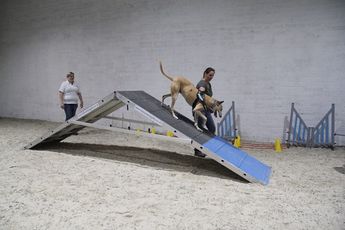 Sometimes you have to be brave, sometimes you need to completely rewrite the rule book (or even ignore the rule book) to change a dog’s life. Meet Slade, he is a rescue greyhound that has had one hell of a life but by having a flexible approach to his agility sessions we have been able to create an engaged, curious and motivated dog that looks forward to every Monday night. Slade’s owner is very cautious about where Slade is let off lead but our specialist training centre is the perfect environment for him. Sally has the confidence that with all the other dogs waiting in our purpose built individual pens and a completely enclosed area, Slade will be able to concentrate on whatever task he is given. Slade, being a large dog, means that he can find the standard 60cm tunnels really hard to complete but by swapping to our 80cm hoopers tunnel (known as ‘Slade’s Tunnel’) Slade can enjoy the thrill of going through a tunnel without undue strain being put on his body. This is just one example of the many ways in which we change what is the norm to make sure that everyone that comes to us is able to take part in whichever activity they want to. ‘We believe in the importance of an enriched and varied lifestyle for all dogs no matter age, breed or ability. To help fulfil this, we aim to provide a wide range of enrichment activities in our specialist coaching centre in Hunstrete, all taught through reward-based methods and adapted to meet the needs of each dog. We pride ourselves on offering non-competitive, fun and friendly agility as one of these activities.’ |

 RSS Feed
Telephone07946222541
|

|